What approaches to couples therapy do we use?
Every relationship has its own history and patterns, so your therapist will tailor sessions to the two of you. Most couples work combines understanding the emotional cycle you get caught in with practical tools for talking, listening and repairing after conflict. Some couples also benefit from an occasional individual session alongside joint ones.
Approaches commonly used in couples therapy include:
- Emotionally Focused Therapy (EFT)
- Gottman Method Couples Therapy
- Cognitive Behavioral Couples Therapy
- Integrative Behavioral Couple Therapy
- Family systems approaches
- Communication skills coaching
What is couples therapy?
Working on the relationship together
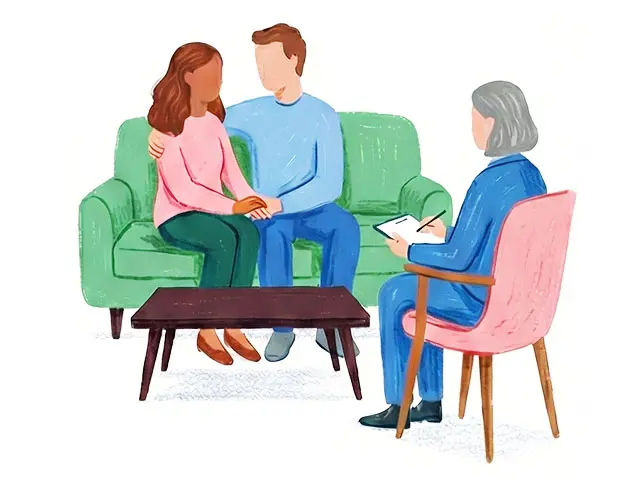
Couples therapy brings both partners into the room with a therapist who supports the relationship rather than taking sides. It welcomes couples of all kinds — dating, engaged, married, LGBTQ+ — and can help with:
Sessions give you both a calmer space to say what’s hard, really hear each other and notice the cycle that takes over when things heat up. Your therapist helps you practice new ways of responding and repairing after ruptures — whether you’re strengthening a good relationship or working out what comes next.
Benefits of couples therapy
Research on structured approaches such as Emotionally Focused Therapy suggests that many couples communicate better and feel more satisfied after therapy. It tends to work best when both partners take part honestly. There are no guarantees, but even couples who later part often say therapy helped them do so with more respect.
Calmer conflict
Learn to pause escalating arguments and talk through disagreements without leaving lasting hurt.
Rebuilt trust
Work through betrayal or broken promises with structure, honesty and a pace you can both manage.
Deeper connection
Rediscover affection, shared goals and the friendship that brought you together in the first place.
Clearer communication
Say what you need in a way your partner can hear, and listen without rushing to defend yourself.
Signs your relationship could use support
Patterns worth paying attention to
- The same fight on repeat
- Feeling more like roommates than partners
- Avoiding hard conversations
- Criticism, contempt or defensiveness
- Broken trust or an affair
- Disagreements about money or parenting
- Less affection or physical intimacy
- Thinking about leaving
In their own words
Experiences shared by our clients
Theo – project manager
Isla – ceramic artist
Rosa – teacher
Lucas – software engineer
Ivy – illustrator
Nora – writer
Owen – entrepreneur
Frequently
Asked Questions
Questions we’re often asked
Q1: Do we both need to attend every session?
Most sessions are joint, but your therapist may suggest an occasional individual session to understand each perspective. You’ll agree upfront on how information is shared.
Q2: How long does couples therapy usually last?
Many couples notice change within a few months of regular sessions, though deeper issues such as betrayal can take longer. Your therapist will check in on progress with you both.
Q3: What happens in a typical session?
You’ll each have space to speak and be heard. Your therapist helps slow the conversation down, points out patterns and may suggest something to practice before you next meet.
Q4: Will the therapist take sides?
No. Your therapist’s role is to support the relationship and treat you both fairly, helping each partner feel understood rather than judging who is right.
Q5: Is it too late if we’re thinking of separating?
Not necessarily. Therapy can help you rebuild, or help you separate with clarity and respect — which matters even more when children are involved.